Pretest and Posttest Results All Subjects
Writing Scores using Six Traits Rubric 1)Unsatisfactory 3) Satisfactory 5) Proficient Pretest Ideas Organization Voice Word Choice Sentence Conventions Total Fluency % score
This table shows that Subject A and B received the lowest possible score in all areas of the assessment, with an unsatisfactory total score of 20% for their pretest writing sample. Subject E received unsatisfactory scores in the areas of organization and conventions, this reflects poor structure, capitalization, spelling, and punctuation. This subject received satisfactory scores for the 4 remaining traits with a total score of 47%. Subject C received satisfactory scores for all trait areas of writing. This would indicate that this student has a moderate grasp of good writing, but with a score of 60% there is room for improvement. Subject D received the highest score for the pretest writing sample with proficient scores in ideas, organization, and word coice. This subject scored satisfactorily in the areas of voice, sentence fluency, and conventions for their pretest writing sample and received a score of 80%. The scores for these writing samples indicate a range of abilities in writing among these 5 subjects which indicates that this is a good representative sample of the cross-section of the class in writing ability.
Posttest Ideas Organization Voice Word Choice Sentence Conventions Total Fluency % score
This table shows significant improvements for Subjects A and B especially in the areas of ideas and voice for subject A and ideas, voice, and conventions for subject B. Subject E improved in the areas of organization and conventions to receive satisfactory scores in all the trait areas for the posttest writing sample. Subject C improved in all areas except conventions, as this student struggles with spelling. The score of 93% is a significant improvement over her pretest score of 60%. Subject D improved in the areas of voice and sentence fluency. The only area that showed no improvement was in conventions, as punctuation and spelling is a weakness for this student. Six Traits Analytical Trait Writing Scores All Subjects (Northwest Regional Educational Laboratory, 2011): 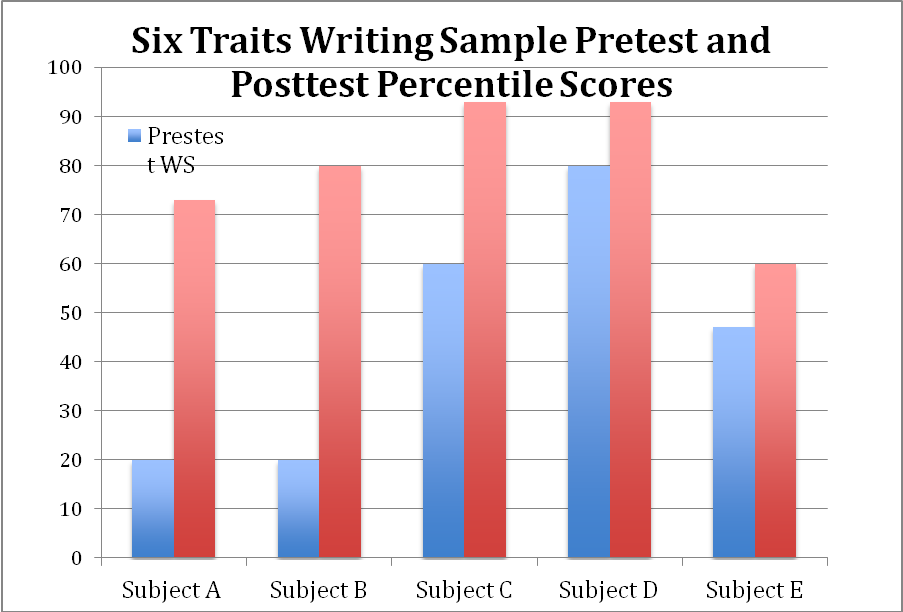 The chart below is a chart of the pretest and posttest scores for Word Analysis. Students received points for each word and word part that was correctly segmented and defined. The scores were then converted to percentages in order to more easily comprehend each students performance. Morphological Word Analysis/Word Mapping Pretest and Posttest Assessment Scores:
Discussion of Pre/Post Change for All Subjects-
The most notable change for all subjects was in the area of word analysis. As a result of modeling the skill of deconstructing words during the read alouds/think alouds, students were more able to recognize affixes and root or base words as many of these were either already recognizable or were encountered several times during reading and therefore, provided good practice in recognizing the morphemes and in segmenting them for meaning. Combining the morphemes for the “literal” meaning of the word was at times problematic. On the word analysis assessment for the word projection, for the students, the definition that would immediately come to mind would be projection of a movie by a projector onto a screen. The “literal” meaning for projection would be pro-forward, ject-throw or put, and ion-thing, state of being or throwing something forward (as in a movie or emotion). The concept of the literal meaning was a difficult concept for these students, but most showed the beginning stages of understanding the logic behind this process. These students benefitted greatly from the explicit instruction of Six Traits writing, which also was reinforced by the classroom teacher as part of a unit in improving student writing for the MCAS test. Students were able to organize their writing and talk about specific qualities of good writing and add voice and good word choice as promoted by activities in class that involved substituting “boring” words with “strong” words that were richer and more descriptive. The conventions portion of the lesson was the most challenging. However, it was clear that as students began to see how words were constructed and deconstructed, their understanding of spelling rules such as dropping the y and adding an i when adding inflected ending, or doubling the consonant when adding ing to words with short vowel sounds helped students make gains in spelling and grammar. The results of the spontaneous writing portion of the TOWL did not yield any significantly different scores from the pretest to the posttest. In fact, some students did not perform as well on the posttest on some of the subtests, while others showed a slight improvement in some areas. The scoring for the spontaneous writing is such that no points are given if the writing does not include proper names and dialogue that would require quotation marks and a comma to set off the quotation. All but one student’s results for the 3 subtests revealed that the students performed better on the contextual language and story construction subtests than the contextual conventions subtest. Scores improved if students used correctly spelled words with three or more syllables. Students who made an attempt at using more interesting words did not receive points if the word was misspelled. This would not have been the case in other assessments. Students would still get credit for ideas and word choice in a trait writing assessment. Therefore scoring for creativity in writing is lacking with this assessment.
|
