Results for: Results for each Subject: |
Summary of Most Significant Findings The most significant findings of the study are reflected in the results for the word analysis/mapping assessment, where all students’ scores improved from the pretest score. Pretest results were lower than expected, as none of the students provided definitions for the words on the upper portion of the test, although the instructions indicated to do so. The most improved area was the segmenting of affixes and providing definitions for those affixes. Some students struggled with segmenting the base word as in the word unreliable. One student segmented syllabically, as the syllable re looked like the affix meaning again, then placed the remainder of the word liable in the suffix section. This would indicate that this student needed more work on looking at the base or root word first, determining the meaning of that word, then looking at the affixes. The order in which words parts are analyzed is important. Knowing the meaning of the root or base word is primary in analyzing word parts. Then the analysis of the affixes will alter the meaning such as in the prefix non, which makes the word meaning opposite to the base or root word meaning. Another noteworthy finding was in the Six Traits (Culham, 2006) writing samples, where most students showed significant improvement. Subject A showed the greatest improvement from the pretest writing score to the posttest with a score increase of 53 % points. Subject B’s writing score improved by 27% points according to the Six Traits rubric (Northwest Regional Educational Laboratory, 2011). Subject C improved by 33%, and Subject D improved by 13% points, showing moderate gain. Subject E received the lowest posttest score of 60% in writing, improved by 13% points from the pretest writing score. The TOWL-3 (Hammill & Larsen 1996) pretest and posttest scores showed no significance in the data to indicate any improvement in overall spontaneous writing. In looking at the subtests for the spontaneous writing tests for pretests and posttests, scores showed no noteworthy improvement, but are worth discussing as part of the individual performance portion of this report and will show slight to moderate improvement in the conventions and language areas for each student. The table and chart below show how each student scored on the pretest and posttest writing samples in each of the six trait areas. The total score was then converted to a percentile score.
Writing Scores using Six Traits Rubric 1)Unsatisfactory 3) Satisfactory 5) Proficient Pretest Ideas Organization Voice Word Choice Sentence Conventions Total Fluency % score
Posttest Ideas Organization Voice Word Choice Sentence Conventions Total Fluency % score
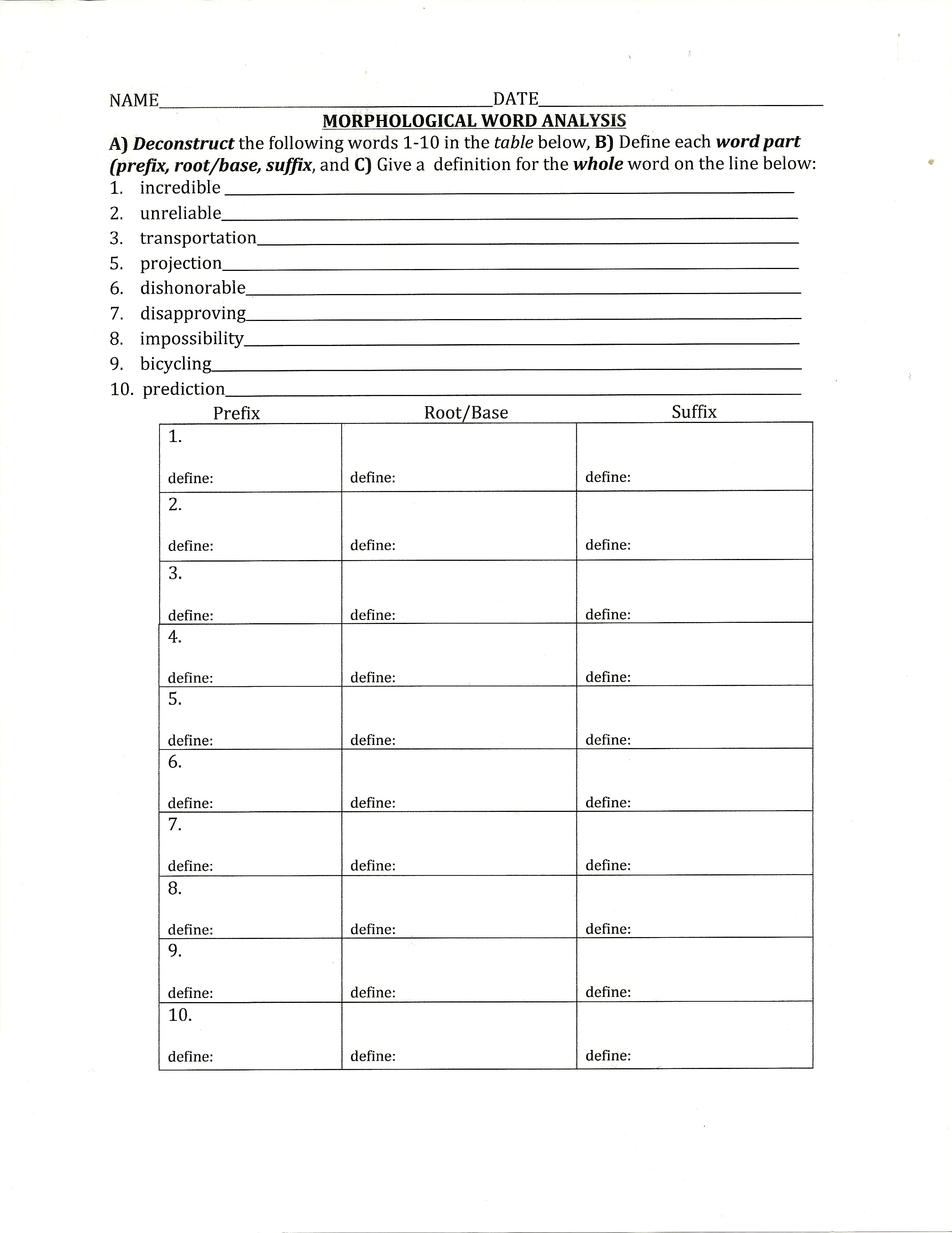
Six Traits Analytical Trait Writing Scores All Subjects (Northwest Regional Educational Laboratory, 2011): Students received points for each word and word part that was correctly segmented and defined. The scores were then converted to percentages in order to more easily comprehend each student’s performance. Students were instructed to segment words and provide definitions for the affixes and roots/base word. All subjects improved in their ability to segment and define the words according to the results of the pretest and posttest. All subjects increased their scores significantly from the pretest to the posttest. The scores ranged from the smallest gain of 25% point improvement by subject E to the largest gain of 35% points by subject B. This would indicate that the instruction in morphological word analysis had a positive impact on these subjects and increased their understanding of word parts, word families, and word analysis. Morphological Word Analysis/Word Mapping Pretest and Posttest Assessment Scores:
|